BVA312 Art History 19/2/19 Fantasy Art Northern European Renaissance
Art History - Week Two 19/02/19
Sister Wendy Beckett - Italian Renaissance
Story of Painting 3 of 10 you tube
Essay is about topic that interests me
- Artists
- Art Movements
- Building
- Fantasy Art beginnings
1400's - new visions - Brancacci Chapel
Humanity dignified Adam & Eve - suffering but responsible. Medicci family. early arts patrons. Artist - Brother John - Brother (Fra) Angelico. The wealthy wanted their homes decorated and there were new themes offered. Classical world was fashionable - Botticelli. Mars and Venus - Sattires.
A scene with lovers, distance and lowliness.
Andrea Montenga - Northern Italy - official court painter. Manchuria. Interest in Greek and Roman sculpture. Portraits contained beautiful and fantastical landscapes.
Paintings were ordered and precise, scenes had no people. P D. Francesca.
Leonardo da Vinci - a brilliant mind, inventor, artist with an amazing imagination. Mona Lisa is little understood. A great portrait, Mona Lisa is different as she reacts to the artist. The merchants wife, bemused smile. She remains a mystery showing only her reaction not her personality.
Rome 1500 - Pope Julius 2nd rebuilt the city and St Peters cathedral, the largest in the world. paintings celebrate the power of the papacy. Dreams, the escape dream - the perfect world. Painter Raphael. The need to escape through painting. Michelangelo - master sculptor. he didn't like painting, but created the beautiful Sistine Chapel - The Birth of Adam. Beauty alone is not enough, you need spirit, to be a thinking being.
The conversion of St Paul - artist had outlived the Renaissance - reflects in painting.
.
Patronage - artists need money - Churches and rulers (Kings) commissioned art. see PowerPoint for notes. 15th Century started with religious art then re-discovery of classics from Rome and Greece, landscapes followed.
The Medici family - Agnolo di Cosimo comissioned Donatello's David. (David and Golaith)
Bust of Lorenso de Medici by Verrocchio, 15th or 16th c terracotta bust, National Gallery of Art, Washington DC.
Sandro Botticelli (Alessandro di Mariano Filipepi) - The Temptation of Jesus.
 Source: Allart.biz
http://allart.biz/photos/image/Botticelli_82_Temptation_of_Christ.html
Sandro Botticelli (Alessandro di Mariano di Vanni Filipepi) (1445 - 1510)
Temptation of Christ
Fresco, about 1481-1482
345 x 555 cm
Sistine chapel, Vatican
The other chapter of the Northern Renaissance opens in Venice - Two sides of the Alps. it set all of Europe on fire for various reasons and religious conflict - except Venice. The envy of Europe - stable government - painters gave a unique understanding of colour and light.
Bellini official painter to rulers of Venice- looking into the meaningful details - Madonna and Child - scene reflects Jesus dead in Mary's arms.
Titian - a prodigy - took over from Bellini - Titian was a brilliant newcomer.
Bacchus - painting is a full scene, a complete narrative. A magic world, person is saved from eminent danger - painter could feel empathy. The painter is able to take the viewer into his world.
Giorgione - rival painter. The Tempest - many arguments as to the meaning of the painting. Painter died young. Madonna and the Saints - a commissioned work is about time and loss, two world co-existing - neither heaven nor earth.
Titian become very successful. It was a status symbol to possess his work. The Flaying of Masseus - poetry in pain. Story of gods but also the story of the artist.
Nuremberg,Germany - northern Europe - artists were considered craftsman - A Durer. Self portrait, painted for no reason - shows what an artist can be i.e. a gentleman. there followed religious hostilities towards idols and patronage by way of religious commissions dried up with the Protestant movement.
Holbein left Germany and moved to England. painted King Henry 8th, captured majesty and his bullish features.
Out of the city the seasons rules the daily life, lucky to live past the age of 35 years.
Bruegel - Hunters in the Snow - A very honest scene, depicts peasants all looking down desperate to survive.
Best of the bunch - so much in one scene - I'm interested in the narrative.
Pieter Bruegel the Elder
Flemish Artist and Engraver - movement - Northern Renaissance
 |
| Tower of Babel - Pieter Bruegel (c1563) |
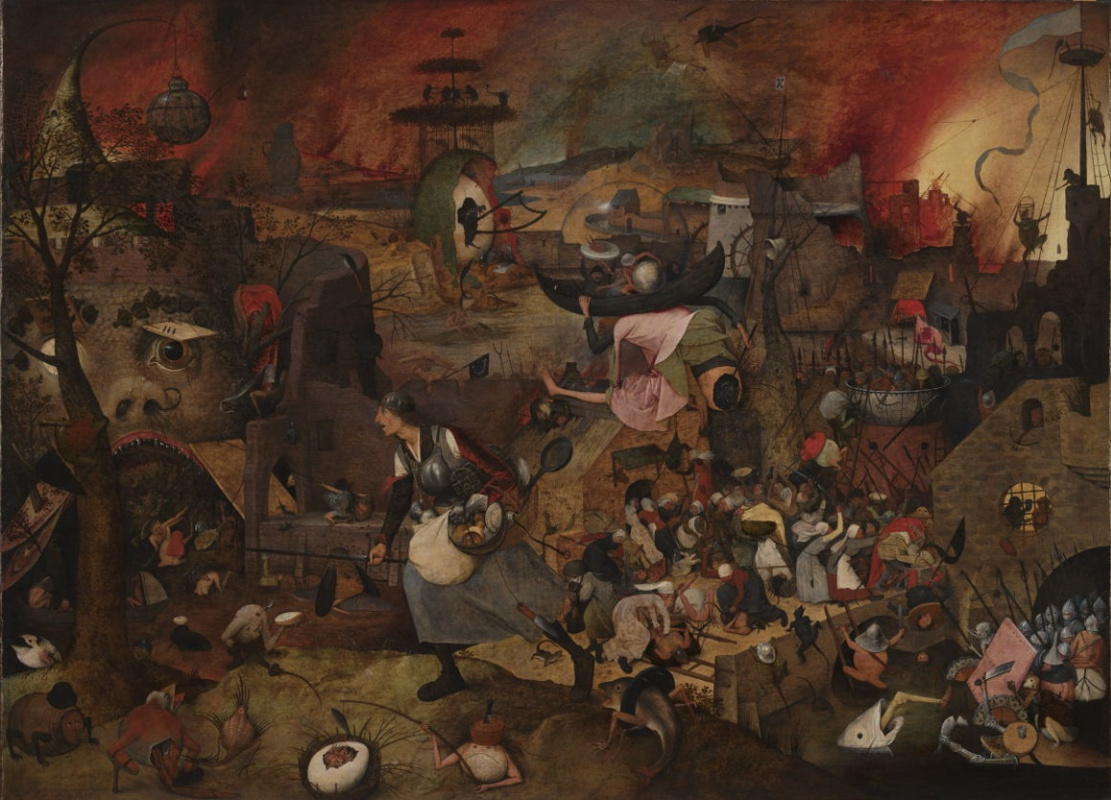 |
| Dull Gret - (Mad Meg) 1562 |
Source ; Wikipedia
Born: 1525-30 - Near Breda, Netherlands
Died: September 9, 1569 - Brussels, Belgium
The Tower of Babel (1563)
Artwork description & Analysis: A vast, partially constructed tower dominates Bruegel's extraordinary 1563 work The Tower of Babel. Surrounding the structure is a landscape dotted with tiny figures, some of whom march in procession around its curving stories, while others toil at the scaffolds along its sides. To the right, ships unload building materials; in every respect of detail, the painting is minutely, naturalistically accurate.
This is one of three paintings Bruegel created around the Biblical tale of the Tower of Babel. In so doing, he chose a story intended to provide a moral directive around the dangers of over-reaching ambition. In the original narrative from the Book of Genesis, God prevents King Nimrod from building a tower designed to reach to the heights of heaven, cursing the builders so that they are unable to communicate in the same language. In this painting, Nimrod is presented in the foreground discussing his project with an entourage of sycophantic courtiers, while enfeebled subjects crawl around his feet. The structure behind him is, in part, intended to be reminiscent of a Roman amphitheater, the Roman Empire being a symbol of the hubris of human ambition in Bruegel's day.
As with so much of Bruegel's work, the moral message also has a contemporary resonance. Living at a time when mainland Europe was being ravaged by rival religious factions - on the one hand, the Catholic empires of the south, on the other the dissenting Protestant cultures of the north - the story of a once morally united, monoglot religious society fracturing into rival groupings was a pertinent one; particularly as one of the founding causes of Protestantism was the translation of the Bible into modern script. Bruegel was sympathetic with the Protestant culture of his home country, and another version of the painting, The Little Tower of Babel" (c. 1568) provides a direct critique of Catholic ceremonial pomp. On one of the ramps extending up the tower, a group of figures marches under a line of red canopies, generally understood to be a veiled reference to the customs of the Catholic church, on whose behalf the Duke of Alba was brutally subduing Bruegel's homeland during the 1550s-60s.
This is one of three paintings Bruegel created around the Biblical tale of the Tower of Babel. In so doing, he chose a story intended to provide a moral directive around the dangers of over-reaching ambition. In the original narrative from the Book of Genesis, God prevents King Nimrod from building a tower designed to reach to the heights of heaven, cursing the builders so that they are unable to communicate in the same language. In this painting, Nimrod is presented in the foreground discussing his project with an entourage of sycophantic courtiers, while enfeebled subjects crawl around his feet. The structure behind him is, in part, intended to be reminiscent of a Roman amphitheater, the Roman Empire being a symbol of the hubris of human ambition in Bruegel's day.
As with so much of Bruegel's work, the moral message also has a contemporary resonance. Living at a time when mainland Europe was being ravaged by rival religious factions - on the one hand, the Catholic empires of the south, on the other the dissenting Protestant cultures of the north - the story of a once morally united, monoglot religious society fracturing into rival groupings was a pertinent one; particularly as one of the founding causes of Protestantism was the translation of the Bible into modern script. Bruegel was sympathetic with the Protestant culture of his home country, and another version of the painting, The Little Tower of Babel" (c. 1568) provides a direct critique of Catholic ceremonial pomp. On one of the ramps extending up the tower, a group of figures marches under a line of red canopies, generally understood to be a veiled reference to the customs of the Catholic church, on whose behalf the Duke of Alba was brutally subduing Bruegel's homeland during the 1550s-60s.
Oil on panel - Kunsthistorisches Museum, Vienna - source The Art Story
I like the amazing stories Bruegel tell in his paintings, to simply gaze upon one for a few moments does not do them justice. The context of the settings in which he painted were difficult times with opposing Christian factions of Catholic versus Protestant. Often themes were biblical but looking at the work I see an early surrealistic aesthetic, although centuries before the Surrealism movement. Bruegel may have well been a source of inspiration for followers of the movement. he was clearly on the side of the Protestants as people were painted in everyday scenes as well as biblical visions. Art was usually commissioned during the Renaissance but Bruegel painted Flemish folklore scenes such as 'Mad Meg'.
Bosch's Garden of Earthly Delights shows a world waking up to the future - Johnathan Jones - from The Guardian.10/01/2017
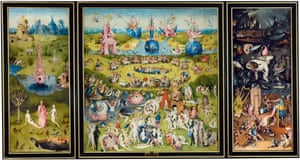
The full triptych of The Garden of Earthly Delights. Photograph: Museo del Prado
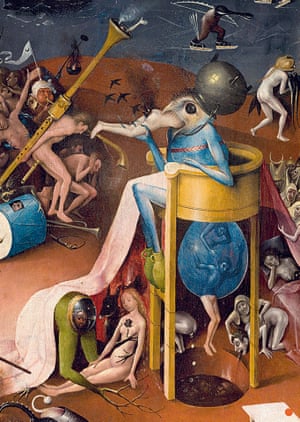
A detail from the ‘hell’ panel of The Garden of Earthly Delights. Photograph: Museo del Prado
The Garden of Earthly Delights by Hieronymus Bosch is a wonder of art. By that I don’t just mean it is one of the world’s greatest paintings. It is also something we wonder at, astonished, like a rare relic in a cabinet of bizarre curiosities. What is happening in this outrageous display of unfettered imagination and what can it possibly mean?
Last year, the 500th anniversary of the death of Bosch was marked by a thrilling exhibition of his paintings and drawings in his home town Den Bosch, in the southern Netherlands. Yet one masterpiece was missing. The Garden of Earthly Delights does not travel from Madrid, where it hangs in the Prado museum. A book of the Prado’s own Bosch quincentenary published this month by Thames and Hudson makes up for that absence. It explores the latest discoveries and theories about Bosch’s most stupendous work with accurate colour images of many of its hypnotic details and infrared images of the three wooden panels that make up this religious – or pseudo-religious – painting.
The Garden of Earthly Delights is a triptych that can be folded open. When closed, it shows a monochrome painting of the creation of the world, with God looking down on a flat landscape sealed inside a giant bubble. Open the tall side panels on their hinges and you are confronted by a world – or rather three worlds – of lurid colour and hallucinatory invention. In the left panel, God introduces Eve to Adam in the Garden of Eden. In the one on the right, Bosch imagines all the sufferings and monstrosities of hell, including a bird-headed creature eating a naked man, a pig dressed as a nun and a hollowed out giant with trees for limbs and an inn inside his pale egg-like torso.
The most hypnotic and perplexing scene, however, is the huge central panel, which depicts a dreamlike landscape of carnal bliss where people cavort naked, consume giant strawberries, explore pink flesh palaces and ride barebacked on fantastic creatures. What on earth is going on?
The Garden of Earthly Delights is popular because we can see surreal images of our own, modern existence in it. Since the 1960s, it has been hailed as a psychedelic romp. Those giant strawberries are like free narcotics at a music festival. What strikes us when we look at it is the sheer joyous excess and mad profusion of this painter’s mind. Was he some kind of heretic, speculating on an alternative lifestyle of free love and fruity fun with no thought of tomorrow?
No such luck, say the authors of the Thames & Hudson book Bosch. They see this mysterious painter as a grimly conservative medieval Christian for whom earthly life is a spectacle of folly and sin with only one destination for those who succumb to its temptations: the horror show that is hell. The seductions of gargantuan fruit and nudity are false, argues this volume of state-of-the-art scholarship, for Bosch is an artist warning of the punishments awaiting all who indulge themselves. This is a long way from 20th-century interpretations that tried to connect him with heretical movements and subversive ideas.
The chances of The Garden of Earthly Delights being a heretical vision of freedom have got a lot smaller in the light of the discovery in the 1960s that it was painted for the princely House of Nassau. This is not a secret attack on orthodox religion but a work that pleased the establishment. In the 16th century, it was seized by the Spanish monarchy and taken to Madrid, where it was revered as a gloomy picture of the consequences of sin. And yet …
One fact made very clear by this book offers another way to consider The Garden of Earthly Delights. It is a very simple fact: the painting’s date. The latest evidence, from scientific dating of the wooden panels to visual connections with other works of art, establishes that it was created between about 1490 and 1505.
That puts it at the heart of the Renaissance, when new ideas were changing Europe. Was Bosch totally immune to those ideas? Was he completely unaware of the printing press, the discovery of the Americas and the swirl of new knowledge and curiosity sweeping Europe?
Knowing this, look again at The Garden of Earthly Delights. It is painted as three superbly convincing perspective landscapes, not unlike Leonardo da Vinci’s contemporary works. Another Leonardo-like touch is the spiralling host of birds rising from a rocky mountain in Paradise. Just like Da Vinci, Bosch has watched birds carefully. He is curious about nature. This curiosity fills his precise, detailed painting. Architecture that seems to be modelled on human organs suggests interests in anatomy, exotic worlds, even science fiction; the giant fruits suggest legends of opulent places far away. Most of all, if this was painted in the later 1490s or early 1500s, the ecstatic nudes may be inspired by images of “naked peoples” brought back by early travellers to the Americas.
There is a curiosity, a freedom of thought, an appetite for discovery in this painting that still makes us see ourselves in it. Bosch painted the modern world before it existed. This Renaissance visionary imagines boundless New Worlds. His masterpiece is a prophecy of us.
This exciting work has been a source of inspiration to figure out where Fantasy Art and Fantastic Art sit as art genres. Often not discussed or studied within the realms of Art History Bosch's masterpiece is considered the earliest fantasy artworks. It has religious themes and iconography, symbols that the medieval peoples of Northern Europe would have understood well. Today we view such ancient artworks with nostalgic eyes and much of the original meanings of the symbology has been lost or changed in its meanings.This work has formed the basis of my art history essay on explaining fantasy art. Influences of Bosch's work can be seen in the Surrealist works of Slavador Dali and pulp fiction artists such as Frank Frazetta who illustrated covers of comics for the Conan the Barbarian series.
Reference:
Jones, J. 10 January 2017


.jpg)
Comments
Post a Comment