BVA312 Nicholas Poussin and Claude Lorrain
Nicholas
Poussin and Claude Lorrain
A Frenchman who spent almost his entire
working life in Rome, Nicolas Poussin is considered the founder of the
French classical
tradition.
He specialized in scenes from the Bible, ancient history, and mythology and his
canvases are revered for their narrative intensity and their rational and
ordered approach to composition. Poussin is admired for his strong use of color
and his inclination to prioritize the cerebral over the emotional. He was able
to demonstrate that art could be an intellectual pursuit and through his
layering of meaning he produced paintings of extraordinary dramatic depth and
allegorical complexity. Towards the latter part of his career, Poussin's art
submitted to a further transformation as he diversified to depict landscapes
and a series of pantheistic allegories that were expressed through the
harmonious forces of nature. Though his reputation was downgraded in the first
half of the 18th century, Poussin enjoyed something of a rebirth in the second
half of that century when the Neoclassicist Jacques-Louis
David and
his followers championed Poussin's style above all other Classicists. Poussin's
reputation has remained buoyant ever since.
Nicolas Poussin was born near the town in
Les Andelys in
Normandy in 1594. He was the child of a noble family who had fallen on hard
times. He was schooled in many subjects, including Latin and letters, but
showed a talent for drawing (he was apparently scolded by his teachers for
doodling in his books). The French Baroque painter
Quentin Varin came
across his work whilst passing through Poussin's town and encouraged him to go
into painting professionally. His parents, however, did not agree which led the
young Poussin to run away to Paris in 1612 aged just 18.


About the Painting - The Realm of Flora (1630)
Here the goddess Flora dances and
scatters blossoms in the midst of those whose deaths and transformations
produced beautiful flowers throughout Metamorphoses, namely Ajax, Adonis, Clytia,
Smilax, Hyacinth, crocus, and, in the center, Narcissus and Echo. The central
position of Narcissus and Echo alone sets their story apart from the others,
such that they literally appear individualistic. However, they are also
figuratively individualistic as Narcissus and his mirrored image are united and
encompassed by a circular boundary that lies within an outer circular boundary
created by Narcissus and Echo. Essentially, a captivating circle from which the
self-infatuated soul cannot escape is created. Echo proffers Narcissus to the
vessel and is pictorially represented as his victim, yet she is also an
accessory to his destruction, as her repetition of his words is what further
fastens him to his reflection. Therefore, in Poussin’s interpretation,
“self-love and self-negation are locked into one diagram of mutual extinction”
(Panofsky). And since self-love and self-negation are at opposite ends of the
individualism spectrum, it can be conclude that Poussin warns against both
egoism and complete dependence. Both conditions create an optical illusion that
enthralls its subject beyond the point of return to mental clarity.
Essentially, a moderate amount of independence is ideal.

This painting, a spectacular example of
Poussin's later landscapes, represents the narrative of the blind giant Orion,
as told by the Greek writer Lucian (125-180 ACE). Art historian Mary Sprinson de
Jesús comments that in this painting Poussin "appears to have surrendered
control and lapsed momentarily in his love of order and geometry, permitting
his imagination to lead him." We can see this from the richness of the
landscape, in which clouds, trees and hills overwhelm the canvas. The sun named
in the title begins to peak over the hill, but from where exactly is unclear.
Unlike many of his earlier landscapes, the figures are not foregrounded and do
not command our attention in the same way; rather, as Orion seems to be about
to move from right to left, the spectator looks towards where he might be
headed, rather than focus on his giant form. It is nature therefore that
overwhelms the figures and represents through painting a new kind of psychic
possibility.
Oil on canvas - The Metropolitan
Museum of Art, New York City

Claude Lorrain was actually born under
the name Claude Gellée (he
came to be called by the name of the region of his birth after moving to Rome).
The exact date of Claude's birth is disputed, but he was most likely born
around 1604 or 1605. Claude was born into a poor peasant family; his father,
Jean Gellée, and
his mother, Anne (or Idatte)
owned a small piece of land in the area.
The artist never married and kept a small
household, but he did adopt a young girl named Agnès in 1658 (some hypothesize
that the girl may have been Claude's own illegitimate daughter). In addition to
Agnès, Claude enjoyed the company of his pupil Angeluccio, and also opened his home to two of his
nephews as he began to suffer from debilitating arthritis. Despite his illness,
Claude enjoyed a long life, finally passing away in 1682.
Lorrain's early paintings are steeped in the northern European landscape tradition, complete with charming picturesque details and compositional surprises. As is unsurprising for an artist who studied and worked in Rome, however, as Claude matured his paintings became increasingly classical in tone and theme. The later paintings are cooler and more idealized, and exude a more melancholy, wistful atmosphere than the more cheerful, bustling early pictures.
Claude Lorrain's paintings are perfect examples of the genre known as the idealized landscape, a type of painting pioneered by artists like Annibale Carracci and Domenichino, and perfected by Claude and Poussin. Claude's landscapes are thus simultaneously rooted in a strong naturalism, but beautified and idealized; Claude never shows the world's harsh realities, but instead a perfect image of nature as it should be.

An idealized landscape –
What do you see? An
idyllic view of the landscape around the Italian town Tivoli. In the center of
the painting is the outline of Tivoli on top of a hill. The city can be entered
via the bridge in the middle. The city is full of big houses and ancient ruins.
On top of the hill in the foreground is the ruin of the Temple of Vesta, which
was built in the first century BC. Lorrain paints
the city during sunset, causing some beautiful light effects. The sky is
somewhat hazy and orange, the edges of the clouds are illuminated, and the
landscape is largely in the shadow. In the foreground, Lorrain paints the Aniene
River, including a small waterfall. The river is shallow and allows the group
of cows and goats to cross the river to have a drink in a safe place. The three
young men and the dog at the back of the herd follow suit. They are surrounded
by some very large trees.

Claude Lorrain's luminous, hauntingly
beautiful landscape paintings may be pioneering works of art in the genre of
landscape, but Claude didn't get there alone. His style is the end result of
years of study from the masters; Claude's major influences range from French
and Italian contemporaries to the Venetian Renaissance.
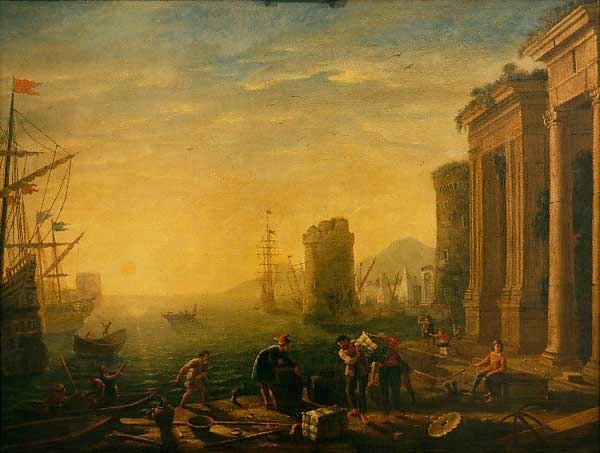
France, Late 1630s - early 1640s
The painting is a repetition of the
famous Seaport, which the artist created in 1637 (the Royal Collection,
London). This piece is characterized by the gentleness of its style, which is
characteristic for the first half of Lorrain's career. Despite its identical
composition, the painting is distinguished by certain details (a different
distribution and quantity of vessels, different staffage, etc.). The arch, one
of the main elements of the image, is significantly simplified, as the artist
often did when repeating his earlier landscapes. The seascape combines
architectural fantasies and real ruins; the Roman arch and portico, the
medieval towers behind them, and, further still, an Egyptian pyramid. However,
the buildings merely serve to emphasize the main theme; the sea and the
sunlight, which reflects off the wonderful architectural décor and returns to
the mirror-like surface to the water. Lorrain painted another repetition in
1674 (Alte Pinakothek,
Munich).

Claude Lorrain's luminous, hauntingly
beautiful landscape paintings may be pioneering works of art in the genre of
landscape, but Claude didn't get there alone. His style is the end result of
years of study from the masters; Claude's major influences range from French
and Italian contemporaries to the Venetian Renaissance.
France, Late 1630s - early 1640s
The painting is a repetition of the
famous Seaport, which the artist created in 1637 (the Royal Collection,
London). This piece is characterized by the gentleness of its style, which is
characteristic for the first half of Lorrain's career. Despite its identical
composition, the painting is distinguished by certain details (a different
distribution and quantity of vessels, different staffage, etc.). The arch, one
of the main elements of the image, is significantly simplified, as the artist
often did when repeating his earlier landscapes. The seascape combines
architectural fantasies and real ruins; the Roman arch and portico, the
medieval towers behind them, and, further still, an Egyptian pyramid. However,
the buildings merely serve to emphasize the main theme; the sea and the
sunlight, which reflects off the wonderful architectural décor and returns to
the mirror-like surface to the water. Lorrain painted another repetition in
1674 (Alte Pinakothek,
Munich).

References
Goldwater, R. and Treves, M. Artists on Art From the 4th to the 20th Centuries
(1972) Book
Merrot, A. Poussin.
(1990) - Book
Artists:
Claude Lorrain
–
https://www.hermitagemuseum.org/wps/portal/hermitage/digital-collection/01.+Paintings/36695/ - Morning at
the Harbour
https://www.tripimprover.com/blog/view-of-tivoli-at-sunset-by-claude-lorrain -Ideal view
of Tivoli discussion
Poussin,
Nicolas.
1594-1665 -Landscape with
Polyphemus
Artable 2019 – synopsis on Dance to the Music of time


Comments
Post a Comment